If you have found that days and sometimes just hours after getting braids or extensions or having your dreadlocks re-twisted, your scalp starts to get really itchy and uncomfortable, then you are not alone.
Itchy dry scalp from braids and extensions is really common, estimates suggest about 30-40% of people suffer from it, and it can last for days or weeks, often developing into severe flaking and a very sensitive scalp. If left untreated it can go on to trigger more fundamental scalp issues such as scalp eczema or scalp dermatitis, with many people in these situations having to remove their braids or extensions due to the irritation to the scalp. Scalp irritation over a longer period can also increase the risk of hair loss.

Synthetic coatings, glues and dyes in extensions and braids along with acetone are all known skin irritants and can trigger contact dermatitis of the scalp.
Some stylists will tell you that an itchy or irritated scalp is just one of downsides of these procedures but actually you don’t have to suffer an uncomfortable itchy or flaky scalp, you can get rid of the problem as long as you take the right steps.
Here are four scalp management steps to take during and after you’ve had your braids or extensions put in or had your dreadlocks re-twisted;
Prevent scalp bacteria growth
Your scalp produces natural oils (sebum) and when extensions or synthetic braids are installed, the scalp typically become sweatier. In addition, synthetic hair retains moisture for longer adding to the problem. Extensions, braids and dreadlocks also attract more dust and dirt.

All this can lead to an overgrowth of bad scalp bacteria. Combined with common microdamage from traction tension from braids, extensions and dreadlcoks, both of these issues can end up depleting and damaging the scalp barrier function, allowing bad bacteria to enter the scalp dermis and begin multiplying, leading to a cycle of itching and inflammation, followed by flaking.
Contrary to a lot of advice, this kind of flaking is not due to fungal overgrowth, and so normal anti-fungal shampoos for dandruff do not work, in fact they may make the problem worse. The cause is dry scalp dandruff caused by bacterial over-growth and requires a different treatment approach.
Prebiotics that help feed beneficial scalp bacteria while inhibiting the growth of bad scalp bacteria are the most effective way to prevent bacterial build up in braided hair, dreadlocks or with extensions.
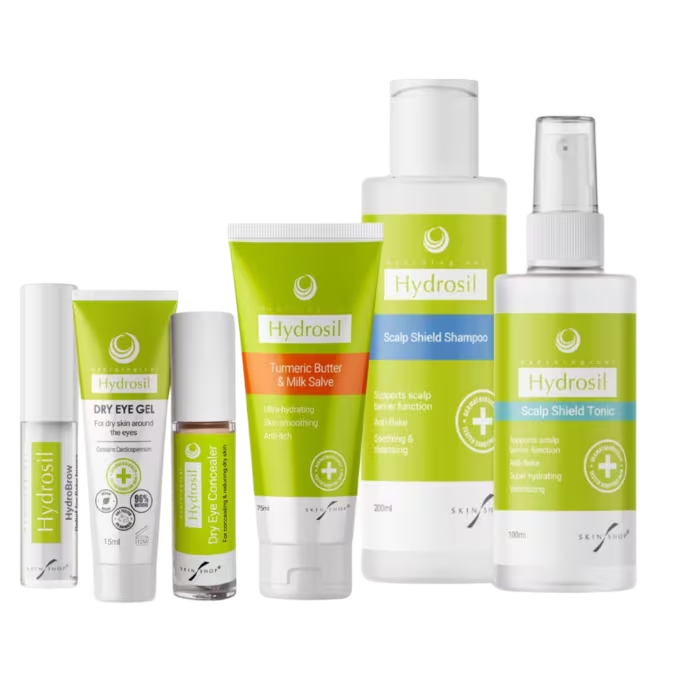
Hydrosil Scalp Shield Tonic is a light non-greasy scalp spray designed for treating dry, irritated and sensitive scalps by instantly calming down itching via a widely reseacrhed plant-derived steroid-mimicking ingredient and strengthening scalp barrier function by boosting good scalp bacteria and inhibiting bad skin bacteria via a patented scalp probiotic. The prebiotic ingredient is derived from a polyfructose extract from chicory root and is proven to rebalance scalp bacteria by encouraging beneficial scalp microbiota while reducing the growth of non-beneficial microbes.
Sarah Smith, a qualified loctician behind The Locs Smith in South London that specialises in dreadlocks says;
"Many of my clients suffer from dry, itchy scalps... Hydrosil Scalp Tonic has been a game changer. Used twice weekly, it quickly cools and soothes my scalp and my clients' after styling. It's vegan-friendly, and I ensure all clients receive dermatologically tested products - it's greatly improving their scalp health and comfort, one scalp at a time."
Jason, 41, a builder from Croydon says: “If you have dreadlocks or braids you probably know what it’s like to have a dry itchy scalp. Dust from work really sticks to my hair making my scalp itch and hair oils I’ve tried to reduce the dryness and flaking just seem to make things worse. Some days the itching drives me crazy, especially in warmer weather or at night.

“I’ve been looking for years for something that’s light and has minimal build up that quicky eases the itching but I wasn’t finding anything effective until a friend recommended Hydrosil Scalp Shield Tonic. The results were amazing and instant. All I have to do now is spray this tonic onto my scalp a few times a week and it immediately gets rid of any itching and leaves me with a fresh feeling scalp. I honestly couldn’t be more pleased.”
Opt for traction-easing techniques
Braids are installed by pulling sections of natural hair tightly into the style, while extensions are attached by gluing extension hair to strands of natural hair. While a snug install helps both braids and extensions last longer, too much tension can irritate the nerves around the hair follicle. When your braids or extensions are installed too tightly or too close to the scalp they can cause inflammation and redness and you may notice little bumps around your hairline or feel itchiness and pain at the roots of where the braids or extensions have been attached.

Over time, constant traction through braids or extensions or tightly twisted dreadlocks may lead to traction alopecia, a form of hair loss caused by repeated tension on the scalp.
For braids and dreadlocks, asking for a slightly looser installation can help avoid or reduce traction tension. It might mean more frequent trips to get your braids re-done but having a less irritated scalp and avoiding the risk of hair loss is definitely worth it.
For extensions, tape extensions can be a much better option than individual loop or bonded extensions as they put less traction pressure on the scalp by spreading the tension across a wider area.

Dry hair just at the roots on low heat
Leaving braids or extensions to dry naturally can cause moisture to sit on the scalp which can trigger irritation and increase the likelihood of fungal growth, which is what can lead to conventional dandruff.
However, drying the roots with heat can also dry out the scalp and contribute to dryness, flaking and itching.

A good compromise is to use a hairdryer on a low heat setting and hold it at least 10m from the scalp and concentrate on just drying drying the roots and not the whole head of hair, which you can leave to dry naturally and then style once dried.
Reduce product buildup
Whether its gels, creams, sprays or hair oils, when used over time consistently or if overused, they can accumulate on the scalp, clog pores and trap dirt close to the scalp. This can significantly add to bacterial build up.

Shampoos that help cleanse the scalp of product build up as well as control bacterial overgrowth are ideal when caring for braided hair dreadlocks or extensions. Hydrosil Scalp Shield Shampoo is chemical- free and fragrance-free with a natural plant-based foaming agent to avoid any irritation from chemical foaming agents. It also contains a scalp prebiotic that promotes the growth of beneficial scalp bacteria to repair and regenerate scalp microbiota while inhibiting the growth of problematic scalp bacteria which can lead to itching and irritation.
Using a leave-in conditioning product rather than a wash off one, applied to the ends and mid-hair but not at the roots can also help avoid product build up next to the scalp.